joy magnetism: National Building Museum


@Joymagnetism, now on Instagram!

Showing posts with label National Building Museum. Show all posts

Sunday, May 22, 2011

LEGO Buildings and Lions - Escape Home to NYC, Part 2, Day 4

Magnet #1185 - LEGO

While I love LEGOs, I'm not like the hugest LEGO fan out there. I didn't really grow up putting them together, and played with them only once in a blue moon. In fact, I think that's why I have so much more fun with them now as an adult.

I inherited a LEGOs set at my old office, so when the kids come in, they'd playdate with me on my cube floor, and we'd build fun stuff. The box wasn't a full-on set, just randoms, so we'd really have to get creative with what we built.

Lemme tell you, if you think advertising creative folks are hard to get along with? Try getting in the way of a 4-year-old's LEGOvision.

If you've read anything from this blog, you know that I'm a big architecture buff, so of course, I'm loving all the architectural sets LEGO's released over the last couple of years. Naturally, my two fave sets are Frank Lloyd Wright's Guggenheim and Fallingwater. I had so much fun putting them together - even as friends and family sat and wondered how old I was. Still. C'mon. They're superduper cool!

My other LEGO fave is the touring Towering Ambition architecture tour that we saw in Chicago. It's currently at the National Building Museum in DC, so if you get a chance to go, you must. It's a cityscape of tall and taller famous buildings from all around the world, all made of LEGO blocks. Freakin' fantastic. And don't even get me started on LEGOLand - I just walk around for ages looking at all of their outdoor diorama displays!

It's been a LEGO-filled weekend, too. Today, I finally braved the Rock Center crowds again to visit the store - they have a new tiny Andy Warhol display, which is superdupercute.

And this weekend, I basically hung out at the New York Public Library for their Centennial Celebration. They commissioned a LEGO artist to put together half-sized Patience and Fortitude, the library lions. Even with 60,000 pieces, they were a tad bit on the small side, but still, damned cool.

I just love my shot below of the awesome Library Lion, reading @MichelleKnudsen's Library Lion, flanked by the LEGO Library Lions. So funny.

It's like the Best. Shot. Ever.


Pin It!

Tuesday, March 15, 2011

Meet Me on Lake Erie, Dearie!

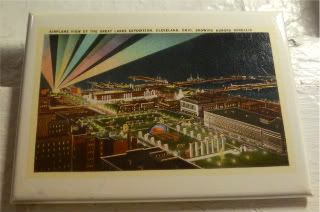
Magnet #1117 - Cleveland, OH World's Fair

Never been to Cleveland. At least, not when I was old enough to remember it. Which is probably why, until the National Building Museum's Designing Tomorrow world's fair exhibit, I never even knew that they had even had a World's Fair there back in the 1930s.

And yet, here it is, the 135-acre Great Lakes Exhibition of 1936. All that's left is Cleveland's Great Lakes Science Center, the Rock and Roll Hall of Fame, and Burke Lakefront Airport. Pretty cool aerial shot, no? At the time Cleveland was the sixth largest city in America (another fact I hadn't a clue about), and the world's fair - like most of the 30s, was an attempt to revitalize cities hard-hit by the Depression.

Wanted to use a Midwest magnet, because I had my first culture clash with the kid from the Midwest a couple of days ago. We were setting up our pavilion for all of our partners, and needed some cleaning supplies. Kansas City dude went out to Target, armed with a list that included paper towels, with a note that said, lots and lots - the big kind.

I've grown to used to New York. To me, that means a three-, maybe four-pack of paper towels. When he came back? He was struggling to carry the fifteen, extra large roll bulk pack! I'm like, dude!

And he goes, you said get the big one! This is big!

Well, can't argue with that, I suppose.
Pin It!

Monday, January 3, 2011

Designing tomorrow

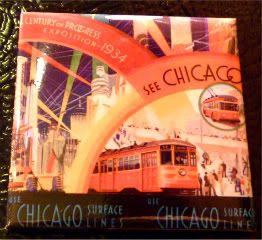
Magnet #1046 - Chicago World's Fair

Three. That's how many times I went through the Designing Tomorrow: America's World's Fairs of the 1930s exhibit at the National Building Museum in DC.

The first time I went through in just over an hour, a tiny bit rushed, only because I was in rush to get to through the gift shop to buy this magnet and then join the hour-long docent tour through the exhibit. A week later, I ended up spending two hours wandering through the eight halls or so, reading the fine print.

I swear, if I didn't start recognizing the volunteers manning the exhibit and the security guards and the guys behind the store register, I probably would have gone a couple more times.

There's some sort of magic surrounding World's Fairs that I've never been able to figure out - most likely, it's a sense of nostalgia, having been to the Knoxville '82 fair twice and then New Orleans fair in '84. But nostalgia's not the only reason, because ya'll know how I love heading out to Queens to see the old structures, buildings, and markers of the 39/40 and 64/65 fairs held there. So much fun.

What I didn't realize was that the 39/40 New York fair was just one of six World's Fairs held across the nation in the 30s, the others being Chicago's A Century of Progress International Exposition (1933–34), San Diego's California Pacific International Exposition (1935-36), Dallas' Texas Centennial Exposition (1936), Cleveland's Great Lakes Exposition (1936-37), and San Francisco's Golden Gate International Exposition (1939-40).

And the Designing Tomorrow exhibit (and accompanying blog) was just amazing, delving into each fair, the exhibitors, but mostly the design components - architecture and building materials, lighting and landscape, transportation and innovation, etc. The breadth and depth of the exhibit is truly remarkable.

My only complaint is that most of the oldies (and me) were bending down too far (indeed, on my haunches a lot, I was) to read the incredibly fine-print captions in like 8-point type (for some of them). But I didn't want to miss an inch of what they had to teach me!

Besides those captions, the exhibit itself is fabulously art deco-ily designed, coupled with giant sweeping images of each fair, gorgeous posters and wall hangings, great artifacts, displays, and videos.

I totally got lost in the wonder of all the fairs, and the 1930s walking through the halls. I loved it. But, I'm sad there's not a Designing Tomorrow catalog, because I would have totally bought one, or two.

When you go see the exhibit for yourself (as you must), definitely spend as much time as you can roaming through it - by yourself, and then take the really good docent tour. For example, without that tour, I never would have known that the first year of the Chicago fair, all the buildings were multicolored, as this magnet suggests. People didn't take to the garish technicolor(y) approach, and so the next year, they painted everything white...which is why Erik Larson's book is not called The Devil in the Multicolored City. Neat, huh.

Anyway, when you're done with the World's Fair exhibit (and the Palladio one and the Lego one and the others), go spend as much time as you can at the museum gift shop...it's one of my faves in DC, and just in general. Fantastic book section, incredibly dangerous for me and my wallet, so I have to avoid it.

They do have a good World's Fair tchotcke section, where I bought a few stickers to turn into magnets...at $10 for two, I couldn't justify (or pick between) all three sets. Hence the stickers, annnnnd maybe one additional one.

So yeah. In all, I'll eventually have seven magnets for one exhibit. Huh.

That New Year's Resolution to take it easy on the magnets is working out so far, I guess. Oops.
Pin It!

Wednesday, December 29, 2010

Losing one's head

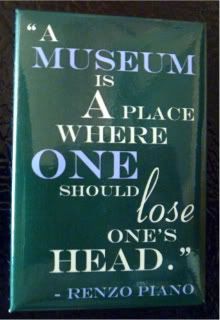
Magnet #1041 - Renzo Piano Museum Quote

Ya'll know I love my architecture. Ya'll know I love my museums. In Renzo Piano, I have a double-double!

Ask anyone and they'll tell you that Italian architect Renzo Piano is one of the premiere museum designers in the world.

I've now seen his work at the Art Institute of Chicago, the Morgan Library in New York, Centre Pompidou in Paris, and the Menil Collection and Cy Twombly Gallery in Houston.

Sadly, my timing was off to see the full renovation for the High Museum of Art in Atlanta and the forthcoming work at the Isabella Stewart Gardner Museum in Boston.

I've yet to see anything of his that I don't like, but one wonders if it's because I'm just partial to museums in general.

Anyway, I picked this magnet up last week at yet another museum, the National Building Museum here in Washington, DC. Yes, I've been there before, and even blogged about it before, but they have some really great exhibits.

Currently, they have the Lego Architecture exhibit that I saw over at Chicago's Museum of Science and Industry a couple of summers ago and a really interesting Palladio exhibit. They also have an ongoing Washington Symbols of Power exhibit, that I wish they'd add a panel to for the WWII Memorial story.

But, the piece de resistance for me and this museum right now, is their World's Fair exhibit, focusing on the America's World's Fairs held in the 30s. I rushed through it quickly last week, and then took a docent tour right afterward. But now, I'd like to go back this week to actually take my time walking through it. And that's when I'll actually do the magnet for it.

For now, Renzo Piano's words ring true for me - museums for me in the last several months have proven the places where I can definitely lose my head. Wandering around the hallowed halls of knowledge, art and history has been a soothing avocation to my usual daily job hunting.
Pin It!

Friday, November 5, 2010

Surveys and renderings

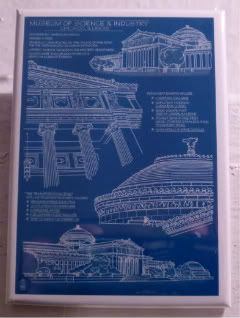
Magnet #987 - Museum of Science and Industry

The magnet is from the supercool Museum of Science and Industry in Chicago. So much fun to be had there! And epiphanies, as well.

The museum building was originally built for the 1893 Chicago World's Fair, otherwise known as the World's Columbian Exposition, as the Palace of Fine Arts. The 140-room building housed 8,000 exhibits, and was one of the great buildings of the fair. (Ya'll know I love my world's fairs. STWsis emailed me about the National Building Museum's world's fairs exhibition that I'm totally gonna see between Christmas and New Year's. I can't wait!)

I won't lie - I love this magnet because it's pretty and blue, and it reads like architectural renderings for the building. Don't worry - even on the real magnet, you can't read the type on the magnet. I tried. With a magnifying glass. (Sheesh, between being deaf last night and not being able to read this puppy, I'm decrepit, I tell you!)

I picked this guy for today, because it's part of what I've learned recently. Art comes in three forms: pictures, sculptures and architecture, which is what I've raved about for the last couple years on this blog.

That's part of why I decided to start a little independent study class for myself, running out and buying an incredibly heavy art history textbook (thank you Barnes & Noble Textbooks!). Each day I'm doing a little bit of reading and notetaking, to at least have some basic knowledge of art history.

Yes, yes, you can't learn everything from books, but I feel like I visit enough museums and galleries, and lectures to count as a well-rounded survey course. Plus, I have an in with the professor!
Pin It!

Tuesday, October 27, 2009

Check each column

Magnet #613 - National Building Museum

There's this interesting sentiment in Ayn Rand's The Fountainhead (that I still haven't finished reading) about how Greek and Roman classical architecture has just been copied over and over again through the ages - in wood, in stone, in marble, and finally, steel and glass. The point being that there's no more originality in architecture.

This is not that magnetpost. After all, the same could be true of television and books and movies, and life, really.

I for one, am always caught between not knowing if I like the classical stuff, or the modernist stuff or the whatever stuff. I tend to just like some design, and some not. No rhyme or reason for my tastes, but most likely attributable to not having any architectural training or education in this stuff, as someone pointed out to me today.

Anyway, the National Building Museum is a particular favorite of mine. Besides the really great tour, it's just an awesome building to wander around in, and filled with such history.

It was designed by US Army Quartermaster General Montgomery C. Meigs a couple of decades after the Civil War. Meigs modeled the exterior after Michelangelo's Palazzo Farnese, while the interior was after the Palazzo della Cancelleria, both of which are listed here. And the Corinthian columns were inspired by the ones in Michelangelo's church, Santa Maria degli Angeli. Whew. What a mishmash.

Still, it's totally one of the more interesting government buildings out there. It was the pensioners building! Can you imagine all the Civil War vets and civil servants filing in for their monies during the day, and then at night, the building being used for Washingtonian social gatherings?

The building spent years as a government building before being repurposed with a new life as the National Building Museum Yes. Repurposed. Unlike other buildings we know - crackheads who destroyed Penn Station, I'm looking at you. Now, it's a forum for all things, well, building. Exhibitions, collections, seminars, events, tours, discussions, the works.

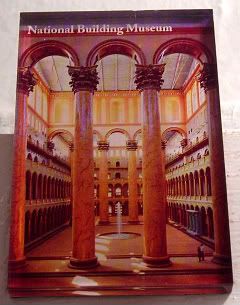
From this magnet, you can see that they weren't joking calling this room the Great Hall - it's 316 feet x 116 feet, and like 159 feet at its pinnacle. You could play football games in here. For reals, yo. Well, ok, you'd have to ditch the 26-foot-fountain in the middle, but you catch my drift. Whoa.

Check out gigantor Corinthian columns in the forefront (see little people to the right?) and toward the back. They're 75 feet high! Eight feet in diameter! Twenty-five feet circumference! Seriously! Of course, I was surprised during the tour to see that it was just bricks...painted to look like marble. Wha?

I do love that on top of the Corinthians, there are 72 Doric columns on the ground floor, topped by 72 Ionic columns on the second floor.

This room always gives me a giggle, because it reminds me of the school project that I didn't do back in elementary school. I haven't the faintest why we were learning about Doric, Ionic and Corinthian Columns in elementary school, but I distinctly remember the three types of columns on posterboard - complete with knife-sharpened pencil guidelines, beautifully hand-lettered labels, painstakingly drawn detailed sketches...by my dad.

What? It's not like I didn't learn the difference between all three of them. I did! I did!

Also? Thanks, Tatay!
Pin It!